Summarize this text with artificial intelligence
Choose your preferred tool to generate a short summary of the text.
The logistics sector is growing at an unprecedented pace in recent years, and companies that can keep up with this speed stand out. Within this growth, being fast is just as important as the stacking and safety of products. This is where pallets come into play. Pallets are the most important part of the outer packaging, ensuring the stacking, safe transportation, and fast handling of packaged products. Palletizing your cargo depends entirely on you and the condition of your cargo. When palletizing your cargo, its destination, fragility, and mode of shipment will help you make your palletization decision. Cargo palletizing also provides convenience during the loading of your cargo. Since machinery is used compared to other loading methods, it reduces labor and saves you time.
What is Cargo Palletizing?
Cargo palletizing is the process of stacking products on pallets with certain standards to facilitate their transportation. If you wish, after placing the products on the pallet, you can wrap your cargo with shrink wrap used in the transportation industry to ready your shipments with minimal external interaction. Carrying products one by one and performing their final unloading creates an inefficient working order. In terms of both labor and time, cargo palletizing is of great importance in logistics.
Why is Cargo Palletizing Done in Transportation?
In international or domestic transportation, cargo palletizing helps in transporting cargo more professionally. Palletizing cargo provides convenience during both loading and unloading.
The benefits of cargo palletizing:
What are Standard Pallet Dimensions?
Pallets used to facilitate the transfer of packaged products are divided into different classes according to both the geographical regions where they are used and the materials they are made of. Pallets classified by geographical regions as Europe, Asia, and standard are also categorized by their materials. There are pallet types with different durabilities made from wood, plastic, and metal materials.
Pallet dimensions can vary depending on the country of export, the material being carried, and the mode of transport, but standard pallet dimensions are fixed. In the international transport sector, standard pallet dimensions are accepted as 100 x 120 cm. This standard pallet, used in these dimensions by many countries, is the most commonly used pallet size.
What are Euro Pallet Dimensions?
Euro pallet dimensions produced within the standards determined by the European Union can only be used if these standards are met. Among these standards, the dimensions, the moisture condition of the wood used, and even the quality of the nails used during assembly are important. The highly common 80x120 cm euro pallet is designed to fit through almost any doorway. Apart from 80x120 cm, euro pallet dimensions also include 120x100 cm, 100x120 cm, and 80x60 cm.
What are Aircraft Cargo Pallet Dimensions?
Air cargo pallet dimensions differ from road and sea transport. The 5 most common pallet dimensions used in air cargo are as follows;
What are the Amazon Palletizing Requirements?
There are things you need to pay attention to when placing products on pallets and shipping them for sale to Amazon. If these requirements are not met during your shipments to Amazon, the probability of Amazon rejecting your cargo is very high. If you ship products on pallets to Amazon, you should pay attention to the following:
How Many Pallets Fit in a Container?
The container sizes commonly used in transport are 20' and 40' containers. Although there is a maximum capacity that these container types can take, sometimes it may be necessary to use less than this maximum capacity. If the weight of your cargo exceeds the limits set when being transported on highways, your container will not be allowed to pass, and you might face heavy penalties. In cases where your cargo is light, you can double-stack if the cargo condition permits, utilizing the container capacity completely.
If you want to load your cargo into a 20' container, you can fit a maximum of 11 Euro pallets of 80x120, 10 Standard pallets of 100x120, and 10 Asian pallets of 110x110 in a single tier. These dimensions are calculated for single-tier loading and are utilized this way.
For your 40' container, if the loading plan is appropriate, you can load up to 21 Standard pallets of 100x120 and 25 Euro pallets of 80x120 in a single tier.
In Which Situations Should Palletizing Be Done?
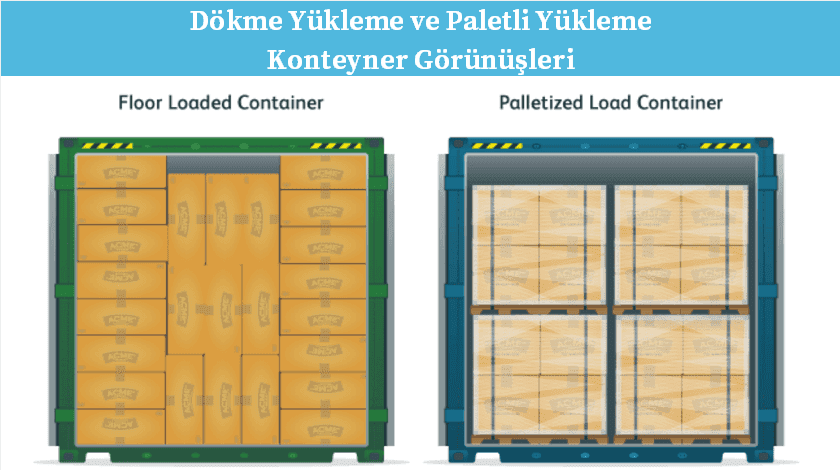
Although we have mentioned the importance of pallets, palletizing is not done in all transport operations. For example, since we cannot fit products like furniture and tables onto a standard pallet, palletizing them would not be correct. In such and similar situations, packaging the products so they will not be damaged is sufficient. Additionally, in FTL and FCL shipping options, the use of pallets might not be preferred as they take up space in terms of volume.
As seen in the visual, in some cases palletizing is not necessary. Since manual handling will be slow in this case, you should make a decision based on your current situation in terms of efficiency.
20’ Container Dimensions
The 20' container is one of the most common container types used in transport. The internal length of the 20' container is 5.895 m, the internal width is 2.350 m, and the internal height is 2.392 m. With a capacity of 33 cubic meters, the door width of the 20' container is 2.340 m, and the door height is 2.292 m. The empty weight of the 20' container is 2,230 kg, and the maximum cargo weight is 28,230 kg, but it must be loaded within the limits set by highways.
40’ Container Dimensions
The 40' container is a container type used for general purposes. Dry cargo transport is commonly carried out with this type of container, which is fully enclosed on all sides. Although the maximum payload weight of a standard 40' container is lower compared to a 20' container, it may be preferred more because it offers more volume than a 20' container.
The internal length of the 40' container is 12.029 m, the internal width is 2.350 m, and the internal height is 2.392 m. With a capacity of 67 m3, the door width of the 40' container is 2.340 m, and the door height is 2.292 m. The empty weight of the 40' container is 3,780 kg, while the maximum cargo weight is 28,230 kg, but it needs to be loaded within the limits set by highways. If you go beyond the determined limits, your cargo will not be allowed on highways, and heavy penalties may apply.
At Navlungo, we would like to assist you with our technology for every type of transport you need in international shipping. At Navlungo, you can quickly get quotes for all kinds of transport you need and ship with confidence.
Table of Contents

Deniz Vural
All Posts